

 Tiếng Việt
Whether covered in pristine white snow during winter or blooming with cherry blossoms in spring, Shirakawa-go retains the serene charm of traditional rural Japan—a place where people live in harmony with nature, far removed from the bustle of urban life.
Nestled amid the majestic Hida Mountains of Gifu Prefecture, Shirakawa-go appears like a fairy-tale painting brought to life. From above, Ogimachi Village—the heart of Shirakawa-go—feels like another world, where steeply thatched Gasshō-zukuri roofs rest under thick layers of snow, wisps of smoke drift gently from wooden windows, and the Shōgawa River quietly winds through the village like a silver ribbon. Whether winter cloaks the village in white or spring paints it with cherry blossoms, Shirakawa-go preserves the timeless tranquility of old Japan—where life flows in harmony with nature, far from urban noise.
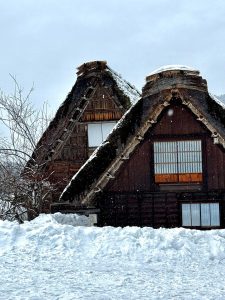
The soul of Shirakawa-go lies in its Gasshō-zukuri architecture—traditional thatched-roof houses with steep slopes of nearly 60 degrees, resembling hands joined together in prayer (gasshō). This unique design allows snow to slide off easily during harsh winters while creating spacious interiors once used for silkworm farming and cocoon drying. Some houses are over 250 years old and are still lived in and carefully preserved today. Stepping inside, you can sense the scent of aged wood, the warmth of the irori hearth, and the soft golden light filtering through shōji paper doors—small details that evoke an unexpectedly intimate and comforting atmosphere.
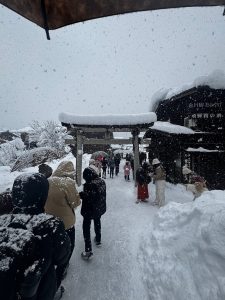
More than just an architectural heritage site, Shirakawa-go is a living testament to the spirit of “yui”—the traditional Japanese culture of mutual support within the community. From building houses and replacing thatched roofs to organizing seasonal festivals, everyone works together, sharing effort, laughter, and responsibility.
Today, even as tourism has brought Shirakawa-go global recognition, the spirit of yui remains deeply preserved. Local residents continue to live simply—cooking over wood-fired stoves, hanging paper lanterns on winter nights, and welcoming visitors with sincere, warm smiles.
Each season in Shirakawa-go unfolds like a vivid painting of nature. In winter, the village is completely blanketed in snow, with light from the Gasshō-zukuri houses reflecting off the white surface, creating a magical scene reminiscent of an Andersen fairy tale. In spring, cherry blossoms bloom along village paths, mirrored in the crystal-clear river. In summer, lush green rice fields stretch endlessly, offering a tranquility that makes you want to linger. In autumn, red and golden maple leaves blanket the valley—arguably the most romantic season for those who cherish nostalgic beauty.

Each season, Shirakawa-go tells a different story, yet they all share the same sense of tranquility and the authentic beauty of traditional rural Japanese life. When visiting Shirakawa-go, travelers should not miss the Shiroyama Viewpoint, where the entire village unfolds before your eyes—a vantage point that has inspired countless postcard-perfect photographs.
Another truly special experience is staying overnight in a Gasshō-zukuri house—listening to the wind whisper through the thatched roof, enjoying a charcoal-grilled Hida beef dinner, mountain vegetable soba, or gohei mochi (grilled rice cakes). These simple yet flavorful dishes reflect the region’s deep-rooted culinary heritage.
As night falls, with snow blanketing the village and warm lights glowing softly through each window, Shirakawa-go transforms into its own quiet world—peaceful, poetic, and unmistakably Japanese.
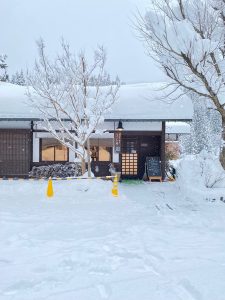
In 1995, Shirakawa-go was recognized by UNESCO as a World Cultural Heritage Site, together with the neighboring village of Gokayama. This honor was awarded not only for its unique architecture, but also because it is one of the rare places in the world where people continue to maintain a life in harmony with nature—not merely surviving, but quietly flourishing amid the modern age.
Shirakawa-go is neither noisy nor showy. There is only wind, snow, and roofs shaped like hands joined in prayer—silently telling stories of the past.
In an increasingly fast-paced world, Shirakawa-go is a place that teaches us to slow down, listen to ourselves, and appreciate the beauty of the simplest things.
For more information about traveling to Japan, please visit:
https://vietcantravelgateway.ca/tin-tuc/
To check the current weather and temperatures in Gifu, Japan, please visit:
https://www.accuweather.com/vi/jp/gifu-shi/223600/weather-forecast/223600